
9:30 PM
I woke up to a flickering tubelight and the sound of somebody looking for a mitten. It was half past nine at night, which is a terrible time to start a day. I couldn’t sit up. The top bunk had about two and a half feet of air above it before the ceiling. If you wanted to sit upright, you had to fold forward over your knees with your head down and your shoulders round, which is not sitting so much as crouching in a way that stung my spine. It also made me look – as I was repeatedly told – like Gollum. I stayed there longer than I needed to, staring at the blank ceiling of the Barrel Hut.
We called them the Barrel Huts, but honestly, they weren’t barrels. They were grey metal boxes bolted onto the side of the mountain like an abandoned construction site. These were repurposed shipping containers, the kind you see stacked six high at a port, except somebody cut windows into these and dragged them up to the snowline. Ours had eight beds and looked like it held about forty people’s belongings. Jackets hung off every hook, bags sprawled across the floor, and the table held what I can only describe as the contents of a grocery store: water bottles, cuppa noodles, sachets, a family-sized packet of gummy bears, and theplas from home packed neatly in their foil.
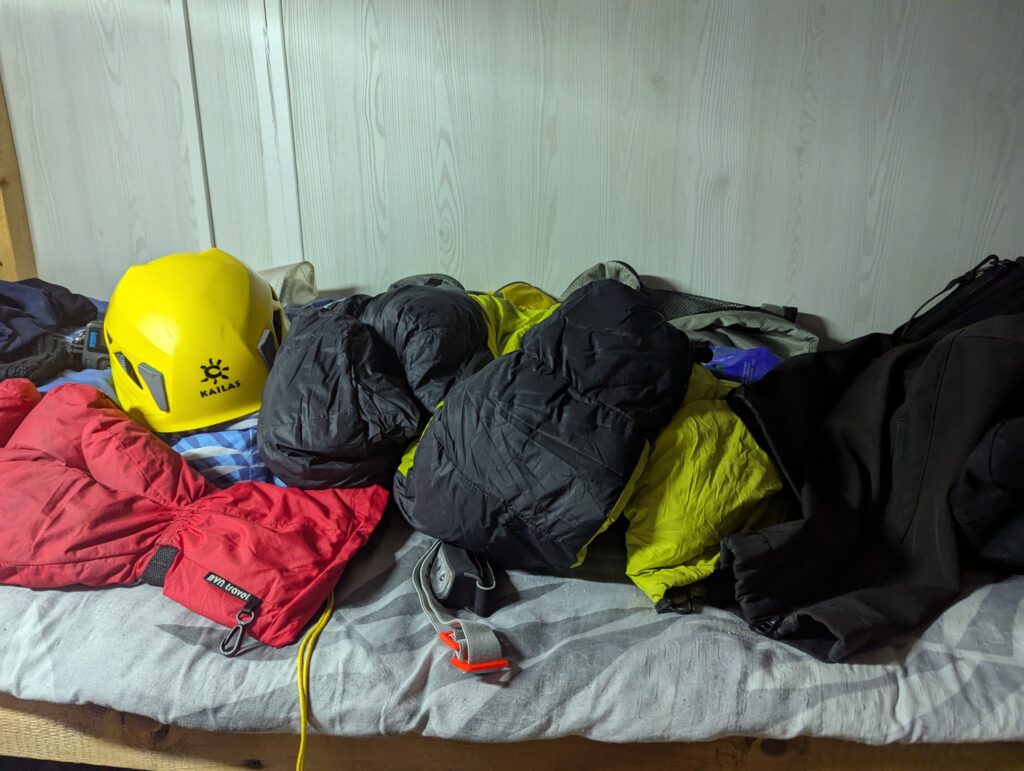
My own bed was no better. Because there was no room on the floor for my items, they were on the bed, and I had spent three nights sleeping on an uneven landscape of down jackets, worn socks, clothes I’d stopped sorting into clean and dirty around day two, and one packing cube that ended up buried under the blanket. It didn’t smell bad, which surprised me, though it was damp from all the snow that was dragged in with our boots.
The hut was buzzing with activity – someone hunting for that mitten, going through the same bag a third time, taking photos. I stood in the middle of it and couldn’t work out what I was supposed to do first. On every other mountain, my dad had been there, and packing was something we did together. This time, he was back home.
10:00 PM
Packing took fifteen minutes, and I didn’t remember most of them. Theplas, spare gloves, and my school flag were all stuffed into a tiny backpack with my fist. My thermos and my water bottle had also resurfaced from my bed. I quickly wrapped a sock over them to prevent the water from freezing, a tip I picked up from our lead guide Nikolai. It looked ridiculous though, two socks with lids sticking out of them. I put on my fleece and my hard shell jacket. I’d slept in my thermals and base layers, which wasn’t comfortable but saved fifteen minutes and a certain amount of misery.
I ate gummy bears the entire time I packed; I’d guess thirty, and I have no defence for this except that they were there and it was quarter to ten at night. Outside, there was an almost visible wind trying to break through the cracks in the metal walls. Inside, against the silence of the night, every small noise gained an absurd volume – the crackle of a sleeping bag, a zip, the plastic rustle of the gummy bears packet.
There were three other people living in the room. One was sick and not coming with us, but still insisted on helping us prepare. One was busy packing, answering my numerous questions, and asking her own, which I hopefully answered correctly. The bunk below mine belonged to the trek leader, Samir, and had been empty for a while, because he’d been up before any of us and was out helping the team.
10:20 PM
The breakfast hut was a seven minute walk away, and calling it a “walk” is generous. It was rock and snow and more rock, steep in most places, uneven the whole way. I could traverse it in daylight with a fair amount of ease, but by night, it became an expedition navigated by my headlamp and luck. Dinner was porridge. I had no appetite but ate it in the name of sustenance, gulping it down in the same manner you took medicines.
11:00 PM
I got dressed. First, fleece pants over the base layer. I wedged my feet into the boots, the warmth seeping out of my toes. Then came the down jacket over the hard shell, the huge one that makes you twice your size and turns your arms into things you swing rather than move. I looked at my watch and felt a little jolt of panic that I was running late. I wasn’t, but there’s a particular anxiety where you glance up and someone is already fully kitted and standing by the door. Within a minute, my harness was pulled up and buckled. Then I put on the woollen cap and a bright yellow helmet over it that made me look like a Minion. Next, a headlamp over the helmet. I was ready, almost.
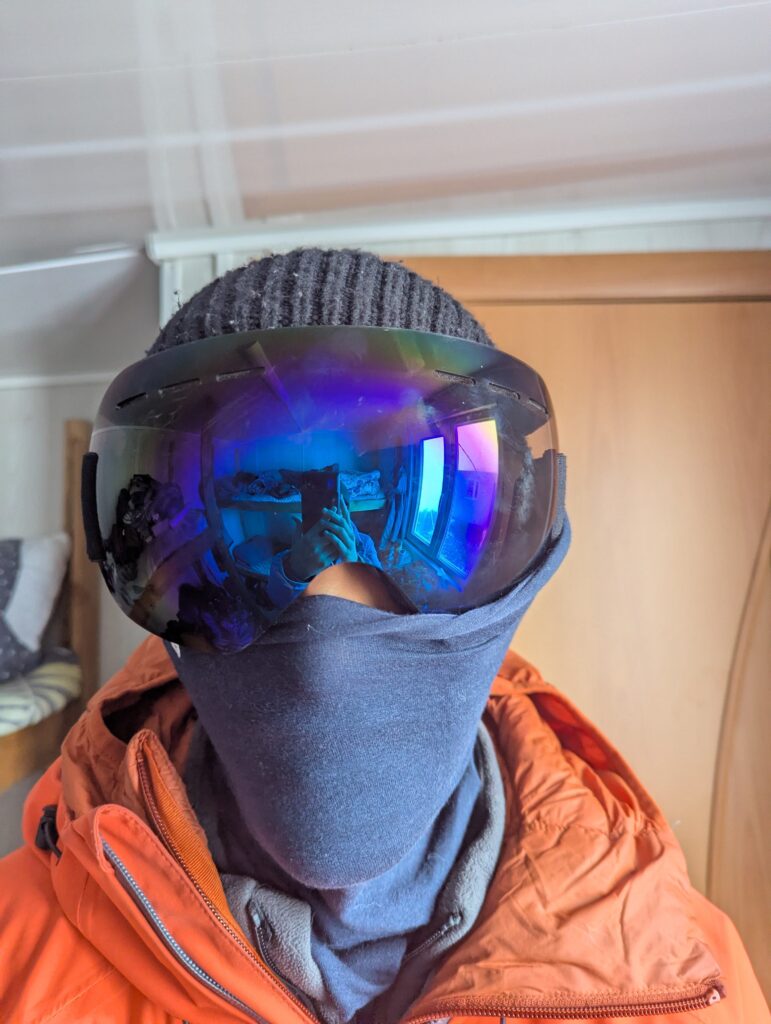
11:50 PM
The wind hit me the second I opened the door, forcing its way through layers of clothing. It was around minus ten degrees. Three days earlier, that number would have meant something to me, but that night it was just the ambient temperature.
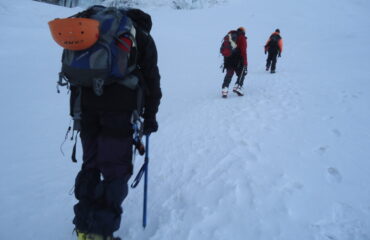
I found a place to sit and put my crampons on bare-handed, because you can’t do the straps properly with mittens on. My hands went numb in about forty seconds, fingertips first and then the whole hand. I kept working through it because I’d done this every day up here and knew roughly how long I had before it stopped being an inconvenience. Putting crampons on was an elaborate process – first front points seated, then heel down, a strap through and back on itself and pulled tight, and the same again on the other boot; then I stood and rocked forward and back and made sure nothing shifted. Finally, I put on my mittens and waited for the blood to return to my fingertips. I also asked someone to slot my ice axe onto the straps of my bag, so that it could be used later on.
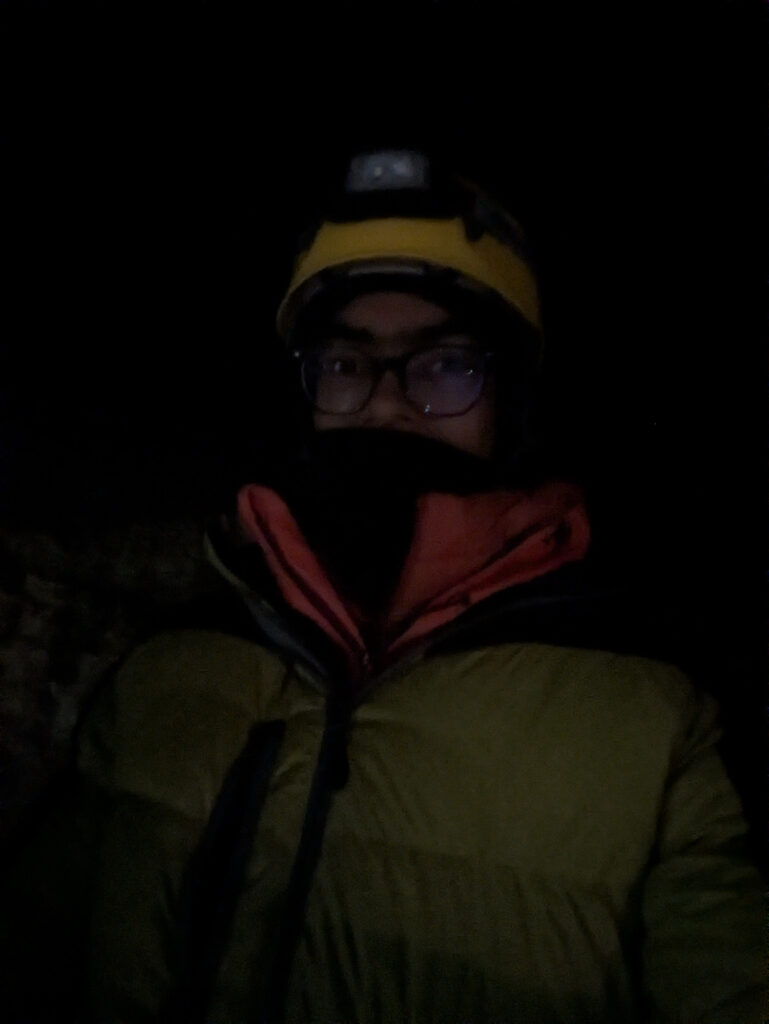
I then went through the route mentally one last time before we would leave. A snowcat will take us up to the Pastukhov Rocks at 4,700 metres, which is where the walk begins. From the rocks you climb a long traverse under the eastern summit, which is the lower of the two, and you keep going up until the ground finally levels out at the saddle. The saddle is the dip slung between the two summits at about 5,300 metres. Then the last push is a steep pull out of the saddle onto the western shoulder across a fixed line. Then a final walk across the summit plateau to the top of Mount Elbrus at 5,642 metres, which is the highest point in Europe. From the top, we would be able to see a panoramic view of the entire Caucasus mountain range across the border of Russia and Georgia.
12:00 AM
Eleven of us walked out onto the snow, ready for Nikolai’s briefing. I liked Nikolai and was also slightly afraid of him, which I think is the correct response to a guide. Aside from him, there was Samir, the trek leader, Aayush, the assistant guide, Maverick, another Russian guide, and Daniel, who was providing extra support for us. Nikolai split us by pace into two groups, and I was in the first one. I looked up to the silhouette of the massif against the night sky, wondering how on earth I would reach the top.
At twelve fifteen, exactly on time, the snowcat came.
12:15 AM
A low mechanical grinding that made its way into the soles of our boots announced the vehicle. Soon enough, the red bulk of the PistenBully came into view with its headlights swinging wide across the frozen slope. It stopped in front of us with a shudder, and the noise it was making while idling was so deafening that Nikolai gave up on speaking altogether and simply gestured at it.
The snowcat was essentially a tractor that was trying to morph into a van. It was the size of a large van, and ran on two huge rubber tracks that allowed it to stay above the snow. There was a small cabin up front for the driver and a flat open bed with benches behind it. No roof, no walls, just a low railing and a faint whiff of diesel. We hauled ourselves up over the treads of the vehicle in our crampons and packed onto the benches knee to knee like paratroopers with our trekking poles held upright between our legs.
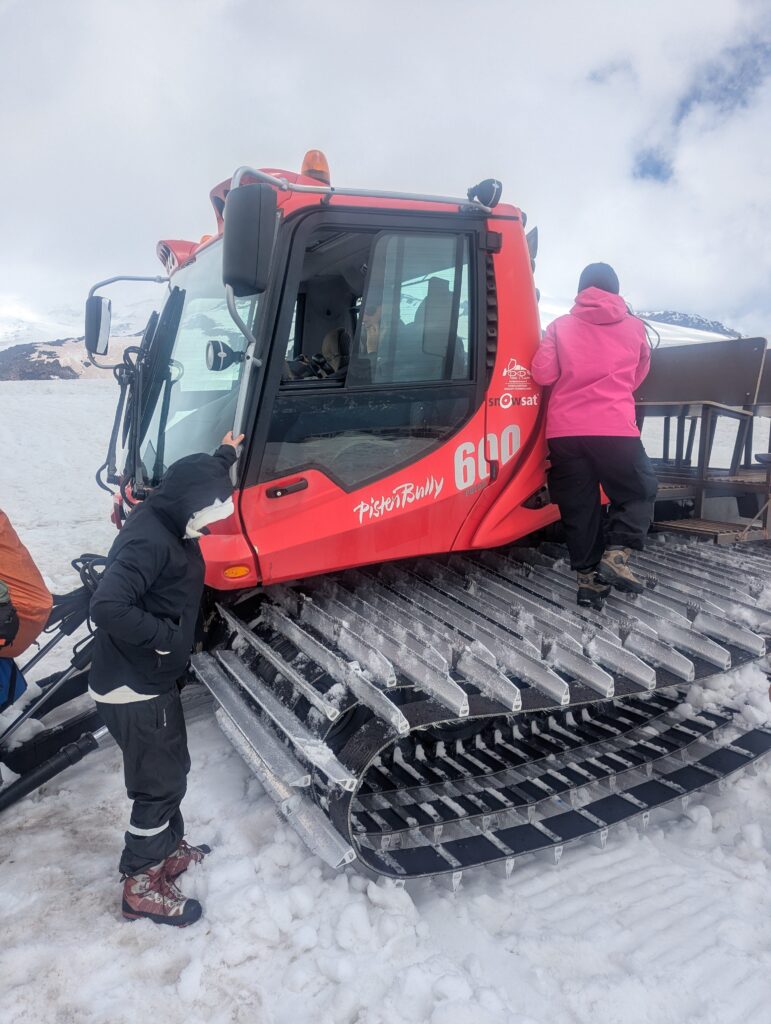
The engine sputtered a few times as the treads bit into the snow. Soon, the whole mountain began to tilt away underneath us.
All conversation had died down within the first metre. The engine took up all the sound there was, and anything you might have said would be a waste of precious oxygen. The cold had also begun to claw at me, ripping through jackets and grasping at my spine. It found the seams between my buff, working at it patiently, and after a few minutes my nose had stopped reporting back. I had forgotten to wear my ski mask, something the wind had decided to make me pay for. My eyes watered uselessly, the tears freezing before they went anywhere. Soon, ice had welded my lashes together at the corners, and every blink came with a small tug. Fortunately, the mask was in my bag. Unfortunately, my hands and feet were warm, so I decided my face would have to lose this time.
At some point I tilted my head up to look up the mountain, turning my headlamp off, and the world I had been seeing went out like a switch.
Everything I had seen since sunset had been the small white circle in front of my boots, and without it the sky became mesmerising, demanding my complete attention. There was no depth to it at first, only a black void, making the mountain and the sky indistinguishable. Then my eyes adjusted and, layer behind layer behind layer, the stars emerged. The more I looked, more of these heavenly jewels began to appear, the black sky now scarce amidst the stars. The bright ones stood out, some even displaying the faintest of colour – a sky blue near the horizon, a rusty orange low over the ridge, and a clean white spot. Clusters and constellations ran from horizon to horizon, ending only once the land intervened.
1:00 AM
After an eternity of rumbling and shivering, the engine changed its note and dropped. We came to a stop on a stretch of open snow that only continued upwards, getting steeper the further I looked.
Just before we set off, I hurriedly pulled my ski goggles down over my eyes, but I had got the strap wrong. They sat too tight across the bridge of my nose and pressed there with a small insistent ache that arrived every few seconds, like a dripping tap.
The first ten minutes were fine. Tough, but manageable.
We started up in single file with our headlamps on, and the world once again shrank to the circle in front of me – the snow, my crampons, and the pair of boots moving in front of me. There was nothing else. The mountain was gone, the sky was gone. The sound of crampons granulating the snow below was the only rhythm I remember. Every time I took a step, the spikes would first scrape through the dry snow on the surface, then bite into the crust of ice below it, and finally my heel would settle in and take my weight.
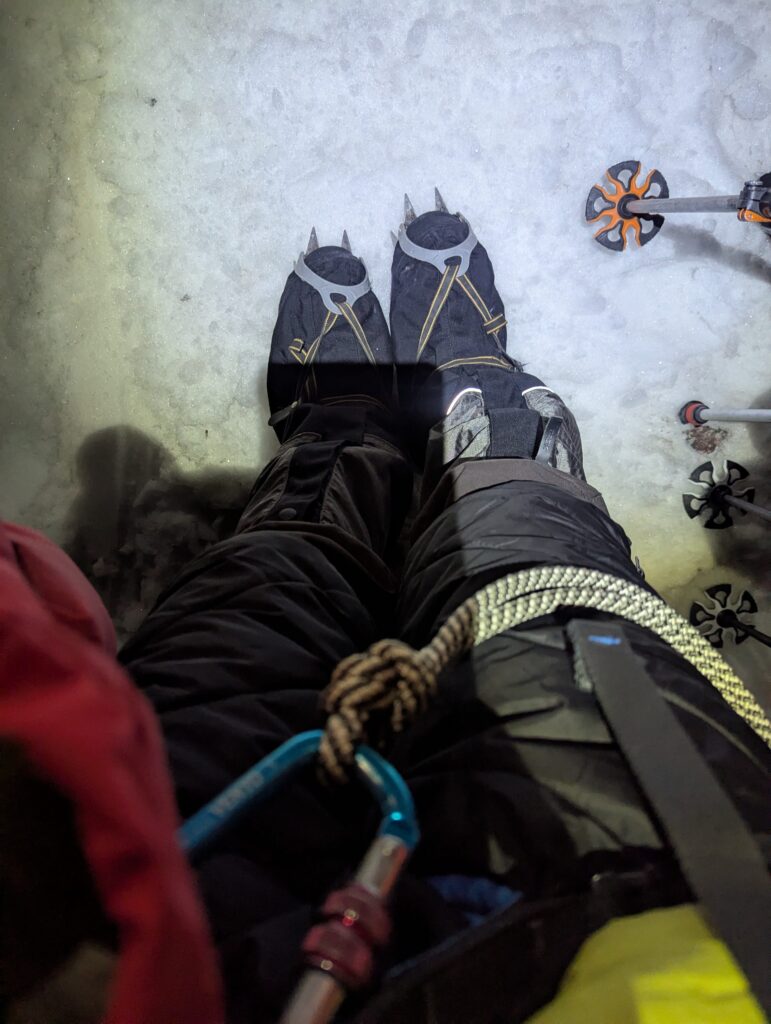
The climb was steeper than anything we had walked in the three days before, steep enough that the ground came up to meet my knee at every step. The powder snow was one thing I wasn’t completely prepared for. Crampons are made for hard snow, for surfaces that push back when you put weight on them, and mine were twenty-four points of very good steel doing absolutely nothing, sinking through a foot of dry powder and finding no floor underneath it. Every step wasted more energy, giving me back a fraction of what I had put in. For every two steps I walked, the snow pushed me one step behind.
The wind itself came in slabs, arriving without any warning and shoving me sideways. It lifted the powder off the surface and drove it flat and fast across my face. The wind was not just corrupting my face with the cold; it was outright stinging me. Before long, there was a sharp, penetrating pain on the left side of my face. I occasionally put a mitten against that ear but was unsuccessful in stopping the barrage of ice and snow.
Somewhere out on that side, past the last few feet my lamp could reach, the slope dropped away. I never saw how far, and I am glad I never saw how far, but you could imagine what followed if you slipped down there. Once, when somebody’s lamp swung wide, I caught a long pale curve of snow bending downward into nothing at all. After that I kept my eyes on the boots ahead of me and made a rule about not looking to the left.
2:00 AM
The walk had started to take its toll on me.
The slipping took more out of me than I realised, heartily dipping into my energy reserves each time I fell. Thankfully, each time I went down onto a knee, there was a hand on my backpack pushing me up again. That was Maverick, the guide walking behind me. He never said anything. He would put his hand there and push, and I would get my feet under me to keep going. I could not thank him at the time, because turning around and speaking were two expenses I could not afford. I remember deciding I would thank him at the top.
The heels I had been following got further and further away. At some point I looked up and the nearest headlamp was twenty feet above me and climbing steadily, and between us a stretch of black snow. I told myself I would close it on the next flat section.
What weighed me down most was not the tiredness which I had expected. It was the sleep. It came up out of nowhere a little after two, and was the most tantalising sleep I had ever experienced, beckoning me into a dreamlike salvation. I found that I was walking three or four steps at a time with my eyes shut behind the goggles and only opening them when I thought I was losing my way. I would tell myself to count to fifty and lose the count somewhere in the twenties. My body had been awake for merely four hours and had reached the private conclusion that the entire project was a mistake.
Soon enough, it became unbearable, so I stopped to the side. I leant forward over my poles with my head down and breathed heavily, shutting my eyes and allowing myself to drift off for a second. But Maverick’s voice came from behind me instantly, telling me to keep walking. I knew he was right, but I stopped anyway. Each time I stopped, the gap above me widened a little more, and somewhere in there I stopped thinking about the summit altogether. The summit had become a thing that other people were going to. I was thinking about the next ten steps, and I wasn’t even confident about the next three.
I put my mitten to my face again and found that the numbness had spread. My left cheek was gone entirely, and my left ear had gone with it. I could push at them with my whole hand and get nothing back. Once again, I was worried but had no choice but to ignore it.
That was when Samir, the trek leader, came to me. He told me to stand where I was and waved the others past. I stood at the side of the trail in the dark, hunched over my trekking pole, watching the headlamps go up one by one. Then he put me in behind him with the second group. I was still struggling, but not as much. Looking back at this moment, there was a chance I would have turned back had Samir not taken me behind.
I also remember calculating my odds of reaching the summit, then realising that the choice of turning back was not available, like how some choices are still greyed out in the early stages of a video game. My legs would keep going up because that was what legs were for, and my lungs and my brain could file their objections in the morning.
I also conceded some headspace to the people at home, the ones who had said, in that reasonable way people say things, that I was a sensible boy and would know when to turn around. In retrospect, the phrase did not survive the night, and was stifled by a million other things I was worrying about. There was no checkpoint up there and no line drawn across the snow, only a face I could not feel, a gap to close, and a slope that went up endlessly.
I put it out of my mind. It took about a second, but I was going up the next.
2:30 AM
Once again, I was dying. I was a walking zombie – eyes half closed, drifting in and out of consciousness, as if I was walking to my doom.
Then the line stopped, and Samir said we were sitting for fifteen minutes. I was overjoyed, and I didn’t sit so much as instantly collapse. I remember the snow creeping into my jackets, but I was too tired to care. The cold had stopped mattering. Everything that had been shouting at me for the last hour went quiet at once, and I lay there in the middle of a mountain in the dark and breathed. For the first time since the snowcat, I was regaining energy. Fifteen minutes is not a long time. I have spent longer trying to make a coffee, but these fifteen minutes rebuilt me from the ground up. Every time I moved, my body still ached, but I had a renewed motivation and I could finally see myself on the summit.
When we stood again, I could feel that something had come back. Not all of it, and not enough to be energetic or even alert, but enough that the first twenty steps went cleanly. There was even a part of me that wanted to push to the head of the group again, but I made it about four steps into that idea before I remembered how much of the mountain was still above me. So I stayed where I was, but with a new ambition.
3:30 AM
The slope left us slowly, something my knees noticed immediately. The ground was not coming up to my shin anymore. My poles were going in ahead of me rather than out to the side. I had been walking for hours in a posture somewhere between climbing and crawling, and I found I had straightened up without meaning to. This meant the saddle, the part connecting the two peaks of Elbrus, was somewhere up there in front of us and the ground was flattening out to meet it. For the first time in the night, there was some sense of direction or a checkpoint, and I was ecstatic to see how far we had reached.
Strangely, I had energy. I was cold in a way I cannot really put down on paper – the left side of my face still absent and my fingers occasionally operational – but the tiredness that had been running through me an hour earlier was simply not there. Fifteen minutes on my back in the snow had revived me, which seemed like a cheat code that I was going to take full advantage of. Unfortunately, problems at altitude are neverending, as I was still occasionally lulled into the velvet cage of taking a short nap.
Somewhere during that time there was a tinge of light that had begun to creep into the night sky. It wasn’t sunrise, but it was something. Nobody turned their headlamps off, and the beams were still doing all the real work, but you could squint and make out some details. Now, the circle coming off of my headlamp had soft edges, and past those edges there was more snow now, going away in every direction and joining up with the sky.
I could also see the drop.
It had been on my left since midnight, and I had made my small private rule about it. But the rule had only held through the night because there was nothing over there to look at. Now, it was no good. The path simply stopped a step to my left and gave way to a drop that seemed to deepen the further I looked. Then my eyes flickered shut for just a second, the same lapse that had been happening for a few hours, but now that single sleepy moment could walk me right off the edge. The thought alone made my stomach drop. A shiver ran down my spine, and my eyes stayed wide open after that.
I continued to walk, longing for the sun and flat land.
4:15 AM
After an eternity, the string of lights in front of me turned the shoulder of the mountain, and everything changed at once.
I had been leaning into a wind coming from the left for four hours, but as the slope bent around to the right, the wind dropped. My world went quiet and a weight was lifted off me. I looked around and noticed there was a ridge and mound of snow cradling us and absorbing all the wind. In the sudden stillness I could hear my own breathing for the first time along with the crunch of eleven pairs of crampons.
In front of us the ground was flat. It was flat. I want to give that word its full weight, because I had not walked on flat ground since twelve in the morning and had begun to suspect I never would again. The saddle stretched out in front of us, a wide pale bowl of snow slung between the two summits.
We walked a little way in and picked a spot in the lee of the saddle. Once again I collapsed. The snow rose up and blanketed me as I lay there with my pack still on and my eyes shut. I did not sleep, but I didn’t quite stay awake either, roaming in the realm of thoughtlessness and peace. Around me, people rustled around, drinking water, organising themselves, and getting comfortable. Five minutes went past with a snap.
I then realised something was nudging my arm. Samir had gone into my pack and pulled out my thermos, holding out the cup. I said I was fine, but I understood that this was not a question and took a swig.
The water flowed through me like a current, and I could feel it rejuvenating my body. The hot water reached places the cold had been sitting in for hours and evicted it. My hands felt like limbs again. My chest loosened. I sat up properly and could actually use my head.
Nikolai was standing a little way off with one of the team, talking quietly. Then he moved to another, going slowly from person to person across the snow. After a while I realised someone had already decided to go down, and Nikolai was rooting out the rest.
I turned to Samir crouched next to me, asking me how I was feeling. I told him the truth, that I was struggling but ready to soldier ahead. He said that if I was okay, I should say so when Nikolai came to me.
It became clear that if there was a list of people to turn back at the saddle, I was at the very top.
I watched Nikolai after that with an entirely different kind of attention. By the time he had come to me, three people had been turned back with a simple sentence.
I almost hopped up when he approached, using energy I did not know was still available, and I told him I was okay. I did so as enthusiastically as I could manage, which was not very, but still a great deal more than I had felt like doing. He was not very convinced and did not pretend to be, but gave me the green light.
Before moving on, he asked how much I had eaten. I froze, doing the arithmetic and coming up with a bowl of porridge and thirty gummy bears. Somehow, that was everything I had put into my body before walking uphill for hours in minus twenty-five degrees.
I went around the team with my hand out. I got a protein bar off somebody along with a bag of energy balls that tasted like sweetened dust. Towards the end, I had gotten a piece of sour candy that sent a sharp chemical jolt right to my brain, waking me up.
4:40 AM
Not before long, someone shouted, “Packs on!”, interrupting my peace. Despite getting up, no one really moved for a few minutes, waiting for the last person to sort out a strap or put on their bag. For once in the entire night I was doing nothing, so I picked my head up and looked around properly.
The sun had come up somewhere off to our right, low and still climbing, and the mound that had sheltered us from the wind was now holding the light off us too. The western summit, however, was golden.
Snow at that hour holds light in a way nothing else on earth does. It’s not white and not yellow, but something warmer and cleaner than either. It shone a colour I have no description for other than that it was an ethereal gold. The entire route was written across that face in that same gold. It was the first time all night I had seen where I was going, and it felt like someone had shined a light upon the darkness enwreathing me.
Then I turned and looked out, and the world simply fell away on both sides.
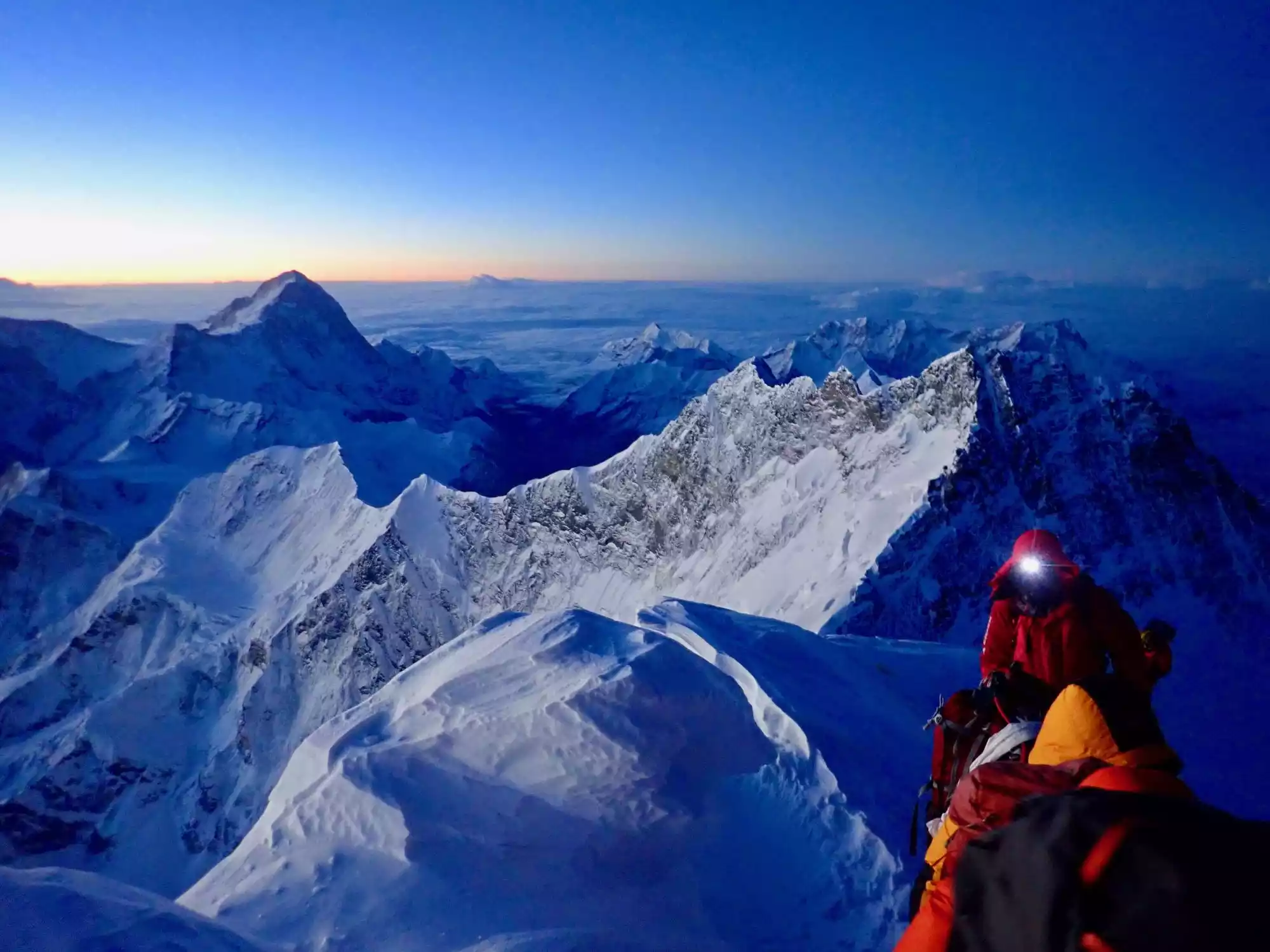
On either side the snow and valleys were gone, drowned beneath a seamless desert of clouds. It was a white expanse so entrancing it felt less like vapour and more like porcelain, stretching outward until the horizon swallowed my sight. Rising out of that sea was the Caucasus. The range tore apart into an endless march of solitary ridges, each clad in heavy snow, unfolding layer after breathtaking layer.
The low morning sun struck with surgical precision. It caught the eastern flanks of every peak in a sharp, burning ember while casting their western faces into a deep, ink-blue shadow. With every successive ridge, the colours washed out, softening to indigo, then to slate, then to azure, and then to a whisper of cobalt until the mountains dissolved entirely into translucent haze. The spectacle had no border. I turned my head left, and the white teeth of the continent dragged on endlessly. I turned right, and it was the same. Hundreds of jagged monarchs, the bedrock of the tether of Eurasia was laid in the dawn, and I was looking down on all of them.
I had walked on great mountains before, but I had never stood above the world itself.
The idea of a photograph arrived soon after. So far, a single picture would have cost me my warmth, but now it seemed worth it. I knocked my mittens together to generate some heat, then pulled one off and dug my phone out and clicked as fast as my fingers would let me.
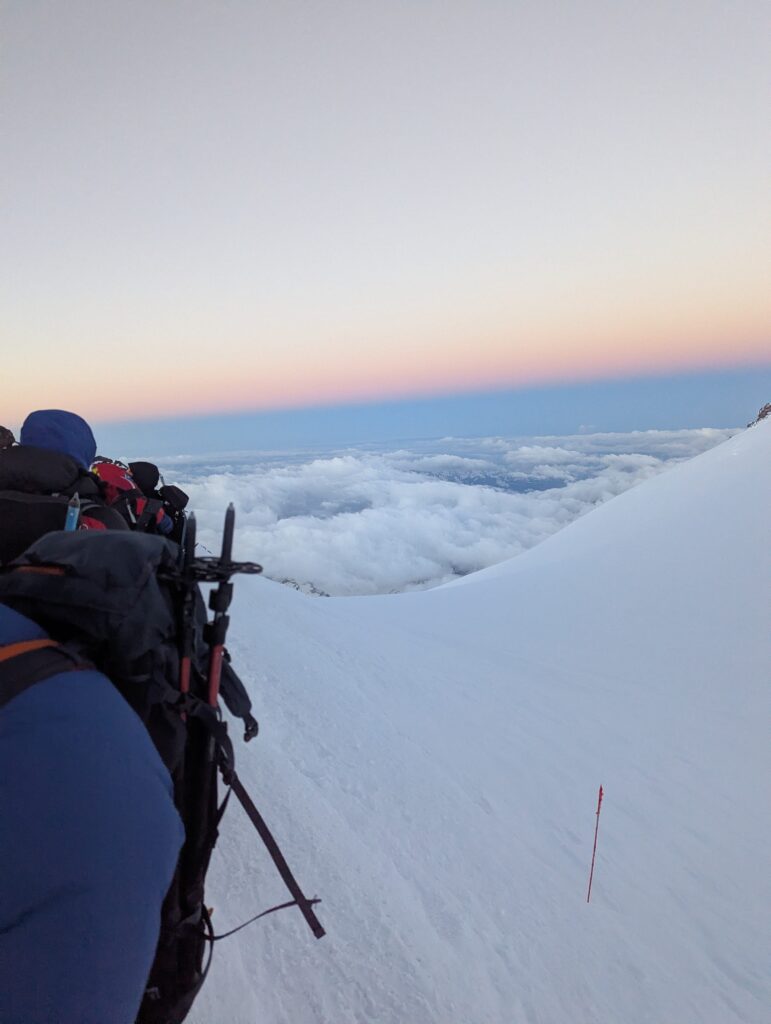
Once everyone was ready, Nikolai said we were going. There were now seven of us left, bunched up in a small tail behind the guide. We set off past the saddle and it was finally easy, which is worth recording because nothing else that night had been, and at last the summit seemed in sight.
Despite wearing enough layers to sweat in Antarctica, I felt the sun on me as we stepped into the light. My energy was at an all-time high, and I was finally warm. Within a few minutes, the far side came up to meet us and the ground began to tilt once again with the fixed lines directly overhead.
5:00 AM
We stopped at the base of the fixed line and left one trekking pole each, finally unsheathing the ice axe. Mine had been dead weight for the night, carried up the mountain purely because I had been told to. Now, looking at the ascent, it seemed obvious why we brought these up.
The lines ran the whole length of that face. Fixed rope, anchored into the mountain at intervals and left there for the season. Section after section of it goes up and across the shoulder, anchoring you to the ice because this was a place where the consequence of a slip is not just a bruised knee. You clip yourself to a sturdy-looking rope with the two carabiners on your harness, making sure it is safe before moving ahead.
The path itself was a scratch across the face of the mountain. In most places it was only wide enough for one boot, and so it was often traversed in a shuffling sidestep with both legs in awkward positions. The snow was also the same dry powder that had been beating me since one in the morning, and every third or fourth step slipped out from under me. On my right, the mountain fell, dropping from beside my boot for a couple of hundred meters of pure ice. There was no gravel to catch me, just a clean white plunge.
Despite slipping constantly, expecting every step to be the one that failed, and moving up a path that seemed to stretch on for eons, I was fine. My legs did what I told them. I did not freeze or panic, and there was no part of me that wanted to take a nap or go home.
The weather, however, did not let up. The saddle had been sheltered, but the exposed shoulder of the mountain was something quite unexpected, the elements charging at us with everything as if they had been holding back earlier. The wind hit us in a tidal wave, lifting the powder off the ground and driving it flat into every seam I had. It was a constant needling blast of ice that stung straight through fabric, and every few minutes it surged. Often the wind morphed into a gust that hit me like a bulldozer, not just making me sway but almost tipping me over. The snow under my boots streamed sideways until it felt like the mountain itself was moving. At times I had to stop altogether, planting the axe and curling down into myself to wait out the storm.
5:30 AM
The fixed lines came in sections, and every joint between them was its own small ordeal. Only one person could unclip at a time, and so every anchor became a queue. Everyone on the mountain that morning was stuck in a recurring gridlock, standing exposed in the wind with axes in and calves burning while whoever was in front sorted themselves out. The switch at the anchor itself had one rule – never stay unclipped. There were always two points of contact and at no moment are you attached to nothing at all, for unclipping even once could be deadly. At nearly every anchor there was somebody standing in that wind doing it for us, reaching over as you came up and moving your carabiners across so you never had to take off a mitten.
6:30 AM
Between two of the sections there was a gap worth maybe ten seconds’ walking, and it was the first place since the saddle where you could truly rest without being attached to anything. Our whole group gathered on it, catching what breath was available.
Three from the team had also been struggling for most of the last section. Nikolai and Samir spoke to each of them, the same way they had in the saddle, and told them they were going down.
Now, four of us remained along with Maverick and Aayush. We were just four people now who had come out of the huts seven hours earlier eleven strong.
We clipped back onto the rope and carried on. The lines ran on for another hour and nothing about them softened, but we moved faster now. Four instead of eleven meant no queues at the anchors and nobody to wait behind. More motivating than that, however, was the summit, now only an hour away.
7:20 AM
At twenty past seven the rope ran out. There was one final anchor with nothing rising from the top of it, and I came off the line with my axe planted, tethered to nothing. After two and a half hours of being attached to the mountain, it felt like freedom.
Five minutes of steep walking remained, and they were the worst five minutes of the climb. My calves were finished, my chest was heaving, and I was counting the steps to the summit.
Then the angle finally let up, something that had felt almost impossible. The ground almost levelled and the summit plateau opened ahead of us. It was a vast pale field of snow tilting gently upwards leading to only one thing: the summit. We stopped at the exact point where the climb became a walk. By the time we sat, there was no energy left in me at all.
7:30 AM
They had told us fifteen minutes across the plateau. It took me almost thirty.
The ground had stopped fighting me and I still could not walk it. That was the cruelty of that last stretch. It was flat enough to walk – a gentle white rise going up to a lip a few hundred metres away. It was the kind of ground I could cover within a minute, but up there it emptied me. I was absolutely spent, running on fumes. Five minutes and I would stop, standing with both hands on my axe and my head hanging.
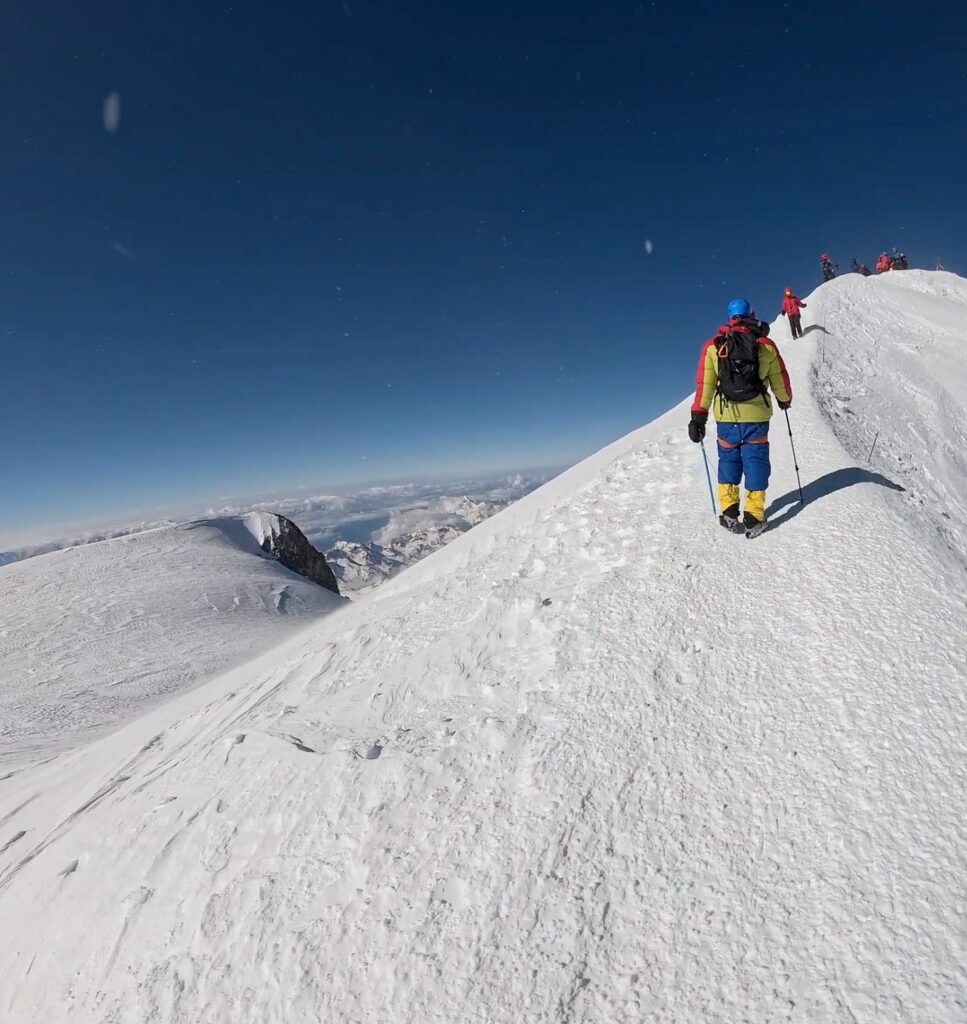
Reaching the West Summit of Elbrus – 5642m
What kept me moving was the lip of the plateau, sitting there a few hundred metres ahead, and the knowledge that the summit was on it. That was all I had left to run on, and it turned out to be enough. Every time I stopped, I would pick my head up and it was closer. The summit now was not just a dream or a possibility; it was in front of me.
Then the plateau ended and the ground stood up one last time. Ten minutes of a slightly steep ridge of snow between me and the sky. At that point, there was no energy left in me, yet my legs simply started working, pushing me up to that summit.
8:00 AM
Finally, there was one more step, and then… nothing. I had reached the summit
The mountain ran out beneath my boots and the whole world dropped away on every side at once, and I was standing on the highest point in Europe.
I was overjoyed and overtired at once. Aayush grabbed my shoulder and shouted congratulations into the wind and somebody else was shaking my hand. I pumped a fist into the air, but suddenly felt the need to sit. I walked to the side, and my legs finished with me entirely. I sat down on a mound of snow at the top of the continent and did not move.
There was quite a crowd up there. Fifteen people at least, since several teams arrived at the same hour. Everyone was hugging and shouting and photographing in a bright chaotic throng. The wind had also worsened again on the summit, coming across the top with real violence.
I looked around the summit from my vantage. The clouds felt miniature now, as if I were looking upon a stick of cotton candy from a distance. Below us, the entire Caucasus lay out in ranks with the sun full on them now, and Europe curved off in every direction underneath a sky I could see the edge of. There was not one thing within hundreds of kilometres of me higher than where I was. After a few minutes of sitting, I finally took the herculean effort and went to take pictures.
There is a counter at the summit, a little mechanical thing you pull to log yourself. I took hold of it and clicked it over, and it read fourteen thousand, two hundred and three.
We took our photographs off to the side with the Indian flag snapping and cracking in the wind between us. Finally, after almost half an hour of freezing in the cold, we left the summit.
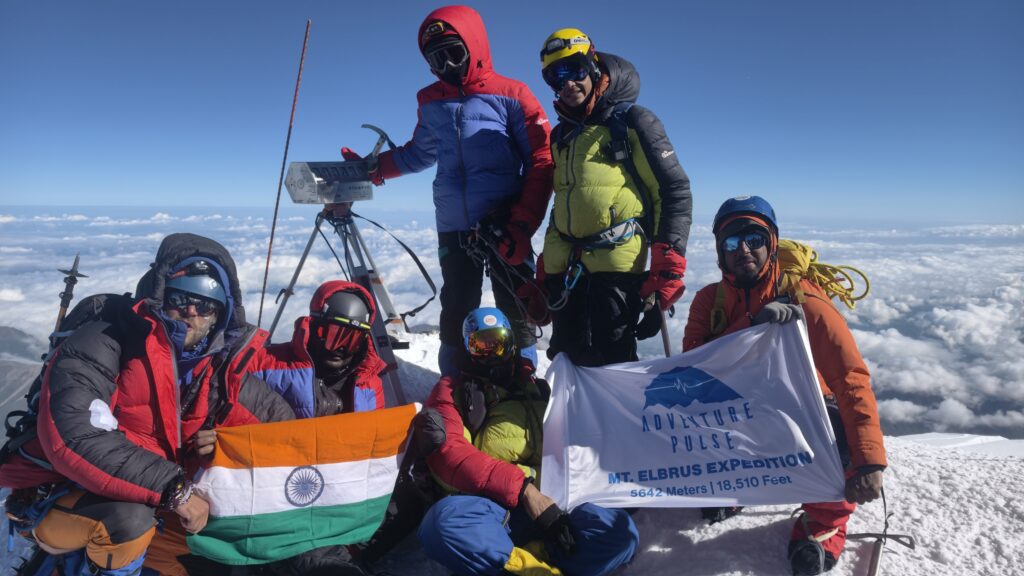
We had spent seven hours walking through snow on half the normal oxygen, at minus thirty degrees, in winds of seventy to eighty kilometres an hour, and we had finally reached the highest summit in Europe – Mount Elbrus.
Author:
This blog was written by 15-year old Shaan Shah from Pune and recounts his experience on the Mt. Elbrus Expedition with Adventure Pulse, specifically detailing the hours before and during the summit push from Barrel Huts (Base Camp) to the highest point of Europe – the West Summit (5642m) of Mt. Elbrus!
You can also follow Shaan’s work on his personal substack!