- Treks
- Baleni Glacier Trek
- Baleni Pass Trek – Extended
- Chadar Frozen River Trek
- Dodital – Darwa Pass Trek
- Gaumukh Tapovan
- Goecha La Trek
- Kashmir Great Lakes Trek
- Kashmir Winter Trek
- Markha Valley Trek
- Miyar Valley Trek
- Nubra Valley Trek
- Pindari Glacier Trek
- Rani Sui Lake and Khanpari Tibba Trek
- Silent Meadows Trek
- Sunderdhunga Glacier Trek
- Climbs
- Corporate
- Calendar
Established in 2010









Brief Itinerary
STANDARD ITINERARY
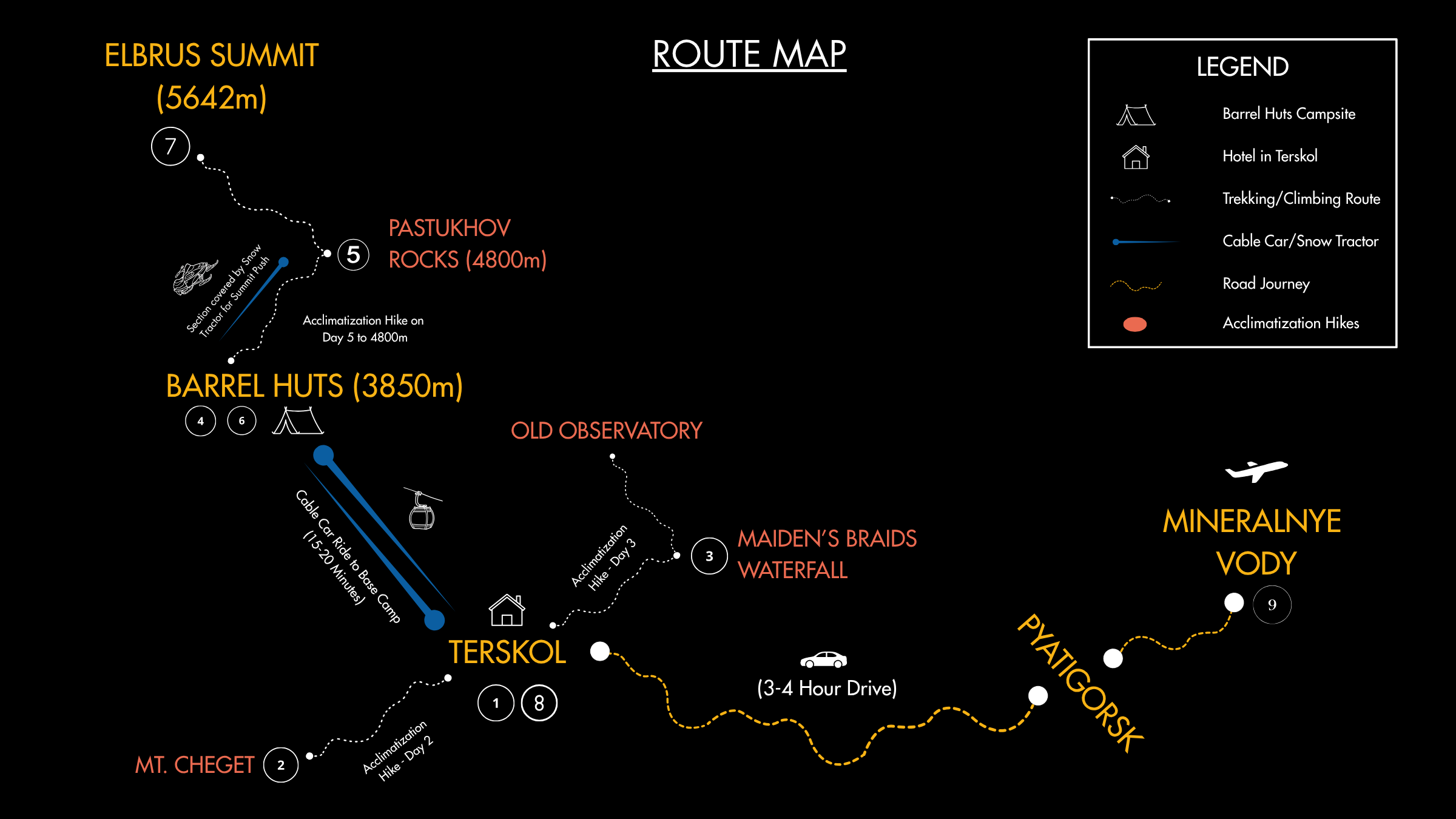
- Day 1 - Arrive at Mineralnye Vody & transfer by road to the picturesque mountain village of Terskol (3-4 hour drive)
- Day 2 - First acclimatization day. Hike to Mount Cheget (3000m). Training to walk with trekking poles and breathing in high altitude conditions.
- Day 3 - Second acclimatization day. Hike to the Old Observatory (3200m) while visiting the famous Maiden's Braids waterfall.
- Day 4 - Take the cable car up to Elbrus and make yourself at home at the unqiue Barrel Huts (3850m). Short acclimatization walk up to 4100 meters.
- Day 5 - Early wake up call. Acclimatization hike to Pastukhov Rocks at 4800-5000 meters.
- Day 6 - Rest & preparation day at the shelter for the summit bid.
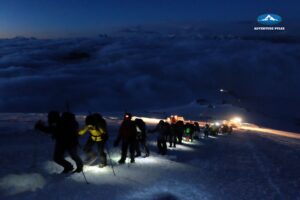
- Day 7 - Finally, Summit Day! Wake up at midnight - the ascent will take roughly 8 to 12 hours & the descent will take an additional 2-3 hours. Overnight at Barrel Huts.
- Day 8 - Buffer day in case of bad weather and potentially second Summit Attempt. Descend to Terskol & Drive to Pyatigorsk (HOTEL NIGHT IS NOT INCLUDED)
- Day 9 - Drive to Mineralnye Vody Airport and fly out!
PREMIUM ITINERARY
- Day 1 - Meet the Adventure Pulse Team at the airport of Mineralnye Vody and transfer to the town of Pyatigorsk (HOTEL NIGHT INCLUDED - Bed and Breakfast Plan)
- Day 2 - Drive to the picturesque mountain village of Terskol (3-4 hour drive)
- Day 3 - First acclimatization day. Hike to Mount Cheget (3000m). Training to walk with trekking poles and breathing in high altitude conditions.
- Day 4 - Second acclimatization day. Hike to the Old Observatory (3200m) while visiting the famous Maiden's Braids waterfall.
- Day 5 - Take the cable car up to Elbrus and make yourself at home at the unqiue Barrel Huts (3850m). Short acclimatization walk up to 4100 meters.
- Day 6 - Early wake up call. Acclimatization hike to Pastukhov Rocks at 4800-5000 meters.
- Day 7 - Rest & preparation day at the shelter for the summit bid.
- Day 8 - Finally, Summit Day! Wake up at midnight - the ascent will take roughly 8 to 12 hours & the descent will take an additional 2-3 hours. Overnight at Barrel Huts
- Day 9 - Buffer day in case of bad weather and potentially second Summit Attempt. Descend to Terskol & Drive to Pyatigorsk (HOTEL NIGHT INCLUDED)
- Day 10 - Drive to Mineralnye Vody Airport and fly out!
Inclusions & Exclusions
Trip Cost Includes:
- 2-nights' hotel stay in Pyatigorsk on double sharing basis on a bed & breakfast plan (ONLY IN PREMIUM PACKAGE)
- 3 nights in Terskol on dorm sharing basis (3 meals included)
- 4 nights accommodation in Barrel Huts (Dorm sharing - 3 meals included
- Rental cost of personal climbing equipment required for the summit attempt (ONLY IN PREMIUM PACKAGE)
- Common climbing equipment (ropes, anchors, etc.)
- Group transportation from Mineralnye Vody Airport to Terskol & back (In case you arrive independently, you would need to hire a private car for the transfer which will be on actuals)
- Cable Car Fees (Terskol to Barrel Huts & back
- Fees and permits for the acclimatization hikes from Terskol to Mt. Cheget & Old Observatory
- Well experienced local climbing guides
- All paperwork and permits
- Visa Invitation Letter
Trip Cost DOES NOT Include:
- Flights in and out of Russia
- VISA procurement
- Lunch and Dinner while in Pyatigorsk or any extra food orders made.
- Tips to staff minimum USD 150 per head (Mandatory)
- Any Kind of Personal Expenses or Tours/Extra Meals Ordered/Adventure or Travel Insurance, Laundry, Phone Calls.
- Any Kind of Drinks (Alcoholic, Mineral, Aerated)
- Personal Climbing Equipment (included in the Premium Itinerary)
- Hiring charges for snow caterpillars or snow ratracks.
- Any additional nights in Terskol/Pyatigorsk if you come down from the mountain early or arrive in Russia before the stipulated itinerary
- Hotel upgrades (solely depending on availability).
- Anything not specifically mentioned under the “Inclusions".
Things to carry
Download as PDFExtreme temperature variations, high altitude, snow glare & proximity to sun are certain factors which necessitate the need to for proper mountaineering equipment. In order to enjoy your experience in the mountains, we have recommended that you carry the following with you:
Apparel
- Thermal Inners - At least 1 pair of Top and Leggings
- 6-8 t-shirts or long-sleeve shirt (cotton / dryfit)
- 2-3 pairs of trekking pants (no denim!)
- 1 Sweater/Sweatshirt
- 1 Fleece Jacket
- 1 Down Jacket
- 1 Waterproof Layer like raincoat or wind-cheater
- 1 pair of hiking boots
- 1 pair of comfortable sandals/floaters/sneakers
- 6-8 pairs of cotton socks (for day)
- 2 pairs of thick/woollen socks (for night)
- Gloves - liner and outer
- Sun hat
- Woollen cap
- Buff
- Climbing Boots – Can be Hired in Pyatigorsk.
- Crampons – Can be Hired in Pyatigorsk.
- Harness – Can be hired in Pyatigorsk.
- Jumar – Can be Hired in Pyatigorsk.
- Ice axe – Can be hired in Pyatigorsk.
Accessories
- Duffel bag / Rucksack (60L+)
- Daypack / Backpack (20-30L capacity)
- Sleeping bag (can be bought or rented)
- 2x 1L Bottles (to carry drinking water)
- Lunchbox
- Torch + Batteries / Headlamp
- Knee/Ankle/Wrist Guards
- Trekking Poles
- Sunblock
- Sunglasses
- Moisturiser
- Hand Sanitiser
- Personal Medical Kit
- Personal Toiletries Kit and Toilet Paper
- Snacks
Fitness
Download as PDF- There are three main aspects of training to focus on – strength training, cardiovascular training, and trekking + trekking alternatives.
- Strength training involves training different muscle groups, so that they can become stronger. There are different exercises for each muscle group, and working them all out 2x-3x a week should be enough to help you get comfortable trekking.
- Legs / lower body - exercises like squats, glute bridges, step ups and leg presses with help you develop stronger muscles in the lower body.
Core - Exercises like planks, bicycle crunches and leg raises can help with core stability; Pilates is also a core-intensive type of workout that will help.
Upper body - Bodyweight exercises like push-ups, pull-ups and dips will help develop these muscles. You can also use resistance bands or light weights to develop them further.
- It’s vital to do plenty of cardio training before your trek, so that you can get the most out of your experience
- Running - This is the most recommended form of cardio activity, as it activates a lot of the same muscles as trekking. Being able to run 10km in 60 minutes will allow you to get the most out of your trek.
Cycling / Swimming - If you have knee issues, or don’t enjoy running, you can also opt for cycling and swimming. Being able to cycling 30-50km or swim for 30-40 minutes, thrice a week, should be good to help you with treks like EBC.
HIIT training / Crossfit - Another option to level up your cardio training is to opt for high intensity aerobic exercises like HIIT or Crossfit, 2-3 times a week
The aim is to get your heart rate up, so you do not get winded on long days of trekking
- Hiking
Try to get outdoors and go for a hike on the weekends! Uphill trails of 4-8 kilometres are will help you get used to trekking. Make it a point to carry a loaded backpack, and walk in your trekking shoes.
- Hiking Alternatives
Climbing stairs, and using the treadmill or stairmaster on an incline, will help prepare you for treks. Make it a point to carry a loaded backpack so that you can get used to the extra weight; and use your trekking boots, so that you can break them in and walk comfortably.
- If you’re confused with all this information, no need to worry! The most important thing with training is consistency, and staying injury-free. Your training week should ideally have
Strength training - 3 sessions
Cardio training - 3 sessions
Hiking - 1 long session, best on the weekends
Rest and stretching - at least 1 day
FAQs
Elbrus Expedition
What are the staying arrangements for this climb?
The staying arrangements in Moscow vary according to the kind of package you’ve opted for. In Moscow – Adventure Pulse will provide you in a comfortable 2 or 3-star hotel close the city center with breakfast on double sharing basis. In case you haven’t taken this package, you would need to make your own stay arrangements in Moscow. In Treskol (The mountain Village), accommodation is in quaint little mountain hotel with a very good bath and eating facilities. This is on double or triple sharing basis. While you are up on the mountain, we stay in the traditional Barrel Huts. This is a dormitory system where typically 5 / 6 people share a Dom. There is a separate kitchen section for meals and the toilets are usually outside the hut.
What kind of physical shape do I need to be to undertake this climb?
You need to be in good physical shape to climb this mountain. It’s the highest point in the continent of Europe and does demand good physical fitness and some bit of prior trekking experience. Please refer to our Physical fitness document for this trek.
What are the entry and exit points for this climb?
One needs to fly to Moscow and then to a town called MineralVody. There are regular flights from Moscow to MineralVody with an average flight time of 2 hours. From the MineralVody airport, Adventure Pule organizes a group pick up to the base village of Elbrus. The drive from the MineralVody airport to the Treskol village is about a 3.5 hrs drive. In case you are not in MineralVody by 1 pm of that particular day, we can organize a personal vehicle for you at an extra cost to reach the Base village of Treskol.
Do I need any special equipment / climbing gear for this climb?
Yes, some amount of climbing gear is required for this climb. Since we spend about 5 days on the glacier, one needs to be well equipped with some personal climbing equipment. The primary climbing equipment one needs is – Climbing boots, crampons, Ice-axe for support and a good sleeping bag. All these can be hired for a period of 5 – 6 days from the base village of Treskol. Our guide will personally come with you on day 2 and help you hire all the required equipment for the climb. We recommend budgeting for about $ 100 - $ 120 for the hiring charges of the climbing equipment. For list of other things and warm clothing to carry, please refer to our link - List of things to carry for the Elbrus climb.
What are the communication systems available on the way?
Regular phone and data services work in the base village of Treskol. You can either pick up a Russian sim card from the Moscow airport or activate International roaming on your phone. While on the mountain also, the area around the mountain refuge also has network and one can make calls and use data services also. So mostly all the days on Elbrus, you can be connected with your family.
What about high altitude acclimatization?
Acclimatization is the most important part of any climb and we ensure good amount of acclimatization. On day 2 of your arrival in Treskol, we spend the entire day acclimatization and also go climb the Cheget peak (3100 Mts) as part of our acclimatization plan. When we move higher up, two full days are dedicated for doing acclimatization walks and hikes before head up for the final summit Push.
What are the food arrangements?
While in Moscow the plan is on bed and breakfast. During the day you can explore the city and try out different restaurants. Upon your arrival in the base village in Treskol, the breakfast is included in the plan, during the day and evening you can explore some nice restaurants and café located in the mountain village. During the course of the trek and climb, all meals are included and are served in the mountain refuge dining area. These meals are usually mix of continental food like – Salads, vegetables, meat and pasta and there is no food around which is specifically meant for the Indian palate. We highly recommend carrying some snacks and packets of ready to cook meals so that one can supplement the meals with something more suitable to the Indian taste.
Will I be able to take a shower or bath during the course of the climb?
Regular shower facilities will be available in the hotel in Moscow and the mountain Village also. But while we are higher up on the mountain, Shower facility is not available for 4-5 days of the climbing period.
What are the emergency medical precautions available for this trek?
The Adventure Pulse staff and guides carry a fully equipped medical kit with necessary medicines and a Oxygen meter. As a standard practice, we check oxygen levels of all our clients twice a day and take the necessary precautions if any irregularity is found in the oxygen reading. In case the problem persists, the client is sent down with a qualified guide.
What happens in case of bad weather on the mountain?
Adventure Pulse usually plans all it treks during the most favourable season on the mountain, but having said that weather is always an unpredictable factor. We usually look at weather reports before leaving for the Summit push. In case the weather is unfavorable for the Summit push, we delay it to the next day. A buffer day/s are always built in the itinerary as contingency if we get hit by unfavorable weather conditions.


Backpack offloading
Western style bio-toilet

3:1 guide ratio

Extra Spacious Tents

Small group size

Group airport pick-ups and drops

Premium dining tents

Personalised attention
Featured Blog Posts
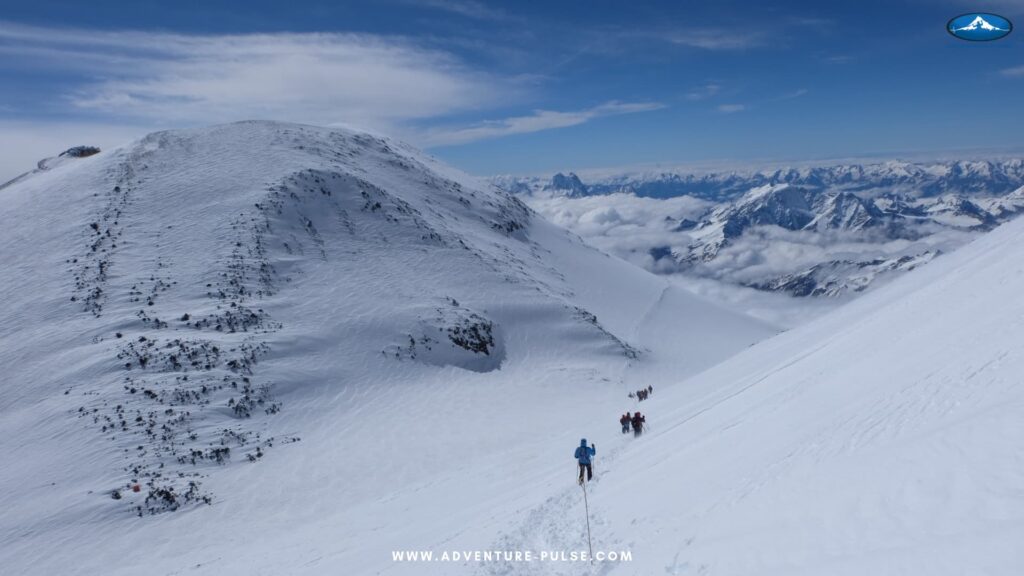 Mount Elbrus Russia – Ultimate Guide for aspiring climbers! - Overview Russia, the world’s largest country, offers unparalleled trekking and climbing adventures across its diverse and extreme landscapes. Spanning over…
 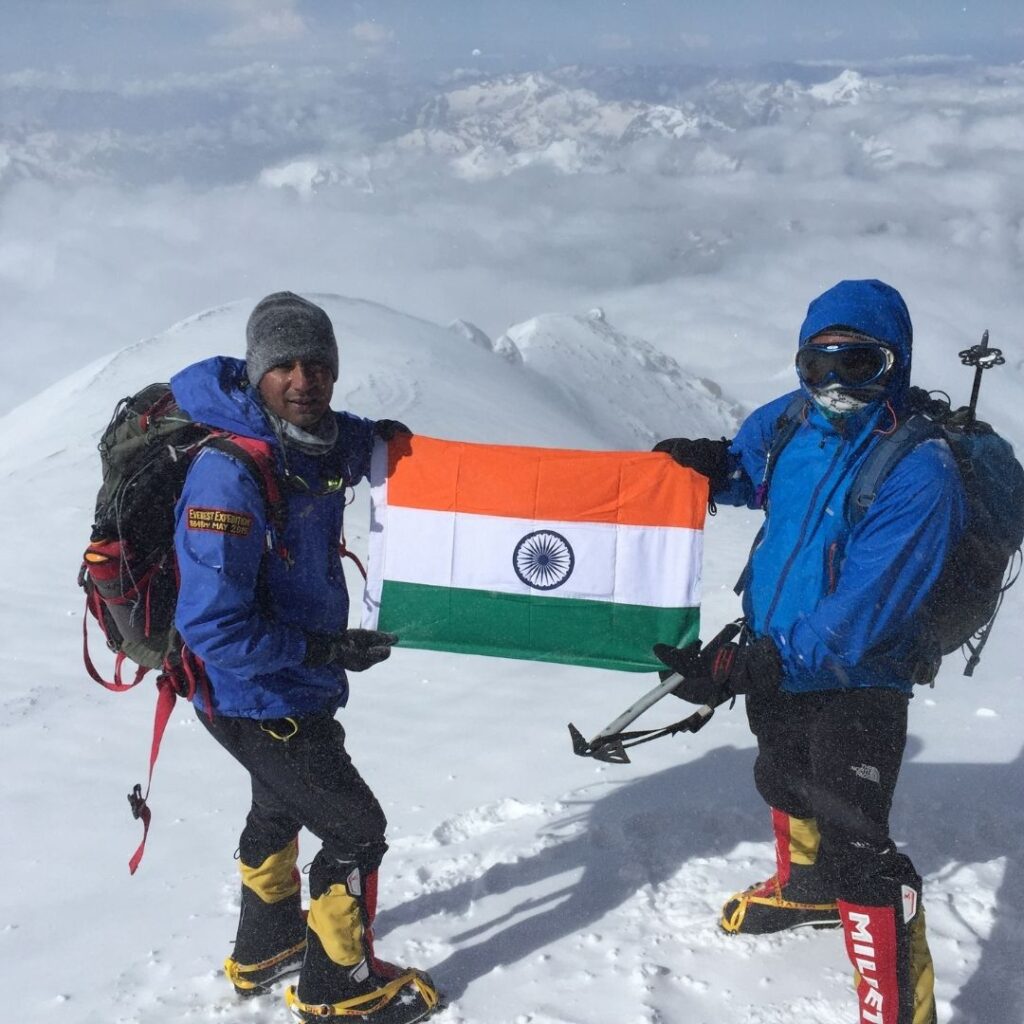 Mount Elbrus, Russia- Physical and mental preparation for the climb! - Overview Mount Elbrus holds the title of the highest peak in Russia, nestled in the Caucasus Mountains, near the border…